Historical Overview
Country: People's Republic of Bangladesh
Main Location: Dhaka, Bangladesh (also Rangpur, nationwide campuses)
Beginning Date: 1–15 July 2024 (quota-reform protests; deadly escalation mid-July)
End of Revolutionary Uprising: 5 August 2024 (Sheikh Hasina leaves Dhaka; interim government under Muhammad Yunus)
Broader Revolutionary Period: 2024 (July–August)
Movement Type: Student-Popular Revolution; Anti-Authoritarian Uprising
Principal Organization: Students Against Discrimination (Nahid Islam, Asif Mahmud, Sarjis Alam, Hasnat Abdullah and coordinators); later broader crowds
Opposing Power: Awami League government of Sheikh Hasina; police and Awami League student wing (Chhatra League)
Major Participants: University students, school-age marchers, Abu Sayed's Rangpur stand, army at the endgame, Awami League cadres, internet-shutdown bureaucracy.
Years used on the map: 2024.
Mapped place: Dhaka, Bangladesh.
The Bangladesh July Revolution of 2024 began as a student campaign against a reinstated government-job quota and became a nationwide revolt after police and ruling-party violence, an internet blackout, and the killing of unarmed protester Abu Sayed in Rangpur on 16 July. On 5 August Sheikh Hasina, in power since 2009, fled to India. An interim cabinet headed by Muhammad Yunus took oath.
Coordinators of Students Against Discrimination — several of them later advisers in the interim government — named the dead and refused palace dialogue on Hasina's terms. July is already a Bangladeshi revolutionary month, as 1952 and 1971 were before it.
1. Quota spark, regime-change harvest.
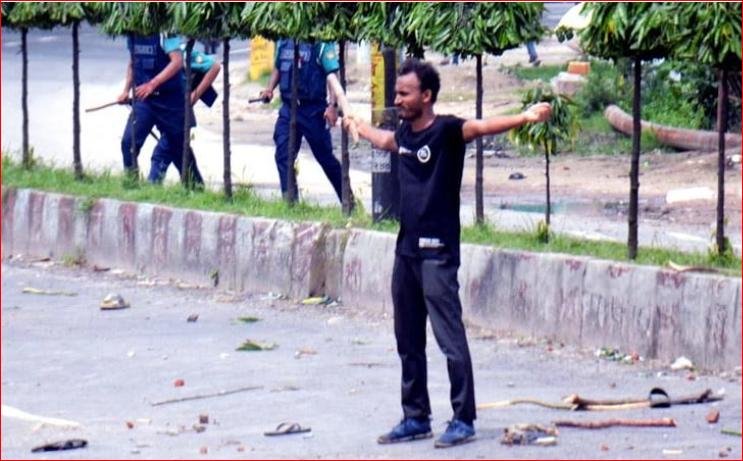
2. Abu Sayed as the visual martyr.
3. 5 August flight of a fifteen-year premiership.
Historical Background and Causes
Hasina's later years combined development statistics with a shrinking opposition (BNP boycotts, jailed critics) and a 2024 election the opposition called uncompetitive. A High Court quota restoration lit campuses that already lacked a legal street.
A. Quota Reinstatement
Merit versus 30 percent liberation-war family quota.
B. Chhatra League Violence
Campus as a ruling-party barracks.
C. 16 July Killings
Abu Sayed and others as moral break.
D. Internet Shutdown
A generation's oxygen cut.
E. March of 5 August
Dhaka's crowd larger than the palace perimeter.
Formation and Organisation
Students Against Discrimination ran press conferences in T-shirts, not parties. After the first massacre days, 'non-cooperation' pulled transport and offices. The army's 5 August posture — not a full Tiananmen for the palace — decided the afternoon. Yunus, Nobel economist, offered an internationally readable interim.
Major Organizations Organization Historical Role Students Against Discrimination Named coordinators Campus crowds First army of July Chhatra League / police Repression Bangladesh Army (endgame) Refused a last massacre for Hasina Yunus interim Post-5 August cabinet
Beginning of the Revolution
Date: 1–15 July 2024 (quota-reform protests; deadly escalation mid-July) Early July sit-ins were quota-technical. Mid-July gunfire and a blackout made them existential.
Rangpur's Abu Sayed, arms open before police shotguns, became the photograph. Dhaka's Shahbag and university areas then filled with a demand that outgrew the quota: Hasina must go.
Major Developments • Early July quota sit-ins. • 16 July Rangpur and Dhaka killings.
• Non-cooperation late July. • 4–5 August 'long march'. • 5 August palace empty.
Non-Cooperation, 5 August and the Yunus Interim
Hasina's last speeches blamed conspiracies. Coordinators were detained and released into more crowds.
On 5 August protesters entered Ganabhaban. The interim government mixed students, NGOs, and old civil society. Trials of the old order, reform of police, and a future election are the unfinished revolutionary state. July's dead are the mandate.
A. Quota fortnight
B. Mid-July blood
C. Non-cooperation
D. 5 August
Major Events and Developments
Date Event Historical Importance 1–15 July 2024 Quota protests Opening 16 July 2024 Abu Sayed killed Moral break late July 2024 Blackout / non-cooperation Generalisation 5 Aug 2024 Hasina flees Revolutionary success 8 Aug 2024 c.
Yunus cabinet sworn Institutional sequel
Key figures
People filed under this revolution: Sheikh Hasina, Abu Sayed, Muhammad Yunus, Nahid Islam, Asif Mahmud, Sarjis Alam, Hasnat Abdullah.
Waker-Uz-Zaman
Birth Date: c. 1966. Birthplace: Bangladesh. Death Date: living historical figure.
Death Place: Dhaka. Role: Chief of Army Staff during the 5 August endgame. Short Description: General Waker-Uz-Zaman's public statements as Hasina left framed the army as a midwife, not a junta of 1 February (Myanmar) type.
Biography: Whether praised as avoiding a bloodbath or criticised as managing a soft landing, he is the khaki of 5 August. Student revolutions in South Asia often end at the cantonment gate; July's gate opened outward for Hasina's convoy.
Classification: Army chief of the transfer. Verification Note: Inter-Services Public Relations briefings of 5 August 2024 record his role.
8. Historical Significance and Legacy July 2024 ended the second Hasina era and installed an interim that must still prove elections and justice for the dead. It sits with 1952 Language and 1971 Liberation as a numbered month in the national revolutionary calendar. The quota was the match; the dry forest was authoritarian fatigue.
1. Flight of a fifteen-year prime minister.
2. Student coordinators as national figures.
3. A provincial martyr image of record.
4. Interim civilian cabinet rather than open martial law.
5. Break of Chhatra League campus monopoly.
6. Mass politicisation of a very young country.
7. Non-cooperation as a working method.
8. Global visibility of Dhaka's July.
Historical Limitations Deaths in the hundreds (counts contested). Revenge violence after 5 August. Awami League supporters at risk. Interim legitimacy debates. Army as silent veto. Old parties circling. Economic stress not solved by a resignation.
Chronology and Conclusion
Year / Date Historical Development early July 2024 Quota sit-ins 16 July 2024 Abu Sayed killed late July 2024 Non-cooperation 5 Aug 2024 Hasina flees Conclusion The Bangladesh July Revolution began with job quotas and ended with a prime minister's empty palace. Students named the dead and then sat, uneasily, in an interim cabinet.
Dhaka's July joined the country's revolutionary months. The election to come will test who owns it.